

By Dominique Nally
At OneHR, we partner with small and medium-sized enterprises (SMEs) in the UK and we know first-hand that handling workplace grievances can be particularly challenging, especially where SMEs initially have limited or no in-house HR support. Effective management of these issues not only fosters a positive work environment but also mitigates the risk of costly legal complications further down the line.
In this article, we explore how you and your management team can proactively manage and prevent grievances.
What should employers have in place internally?
1. Clear Policies and Procedures
First and foremost, it is crucial for businesses to establish clear, written policies and procedures that comply with UK employment law. These should include:
- A Grievance Procedure: A step-by-step process that employees can follow if they wish to raise a grievance. This should align with the ACAS Code of Practice, which sets out the principles for handling grievances at work.
- An Equal Opportunities, Diversity & Inclusion Policy: To prevent grievances related to discrimination, it is best that there is a strong EDI policy that promotes diversity and inclusion at work.
- Anti-Harassment and Bullying Policy: Clear policies that define what constitutes unacceptable behaviour at work and the consequences of such actions.
2. Grievance Training
Making sure to train managers at all levels on how to handle complaints informally, effectively and sensitively, before they turn into formal grievances, is essential. All managers should understand the legal basics, know how to spot potential issues, and feel confident in mediating conflicts. An experienced HR team can deliver this training in person or online for your organisation.
3. Communication Channels
Establishing open lines of communication where employees feel safe to express concerns without fear of retaliation is vital. Regular check-ins and an open-door policy can facilitate this. When someone says something, we all hear it slightly differently. That’s just being human. The key is for your staff to feel able to constructively challenge what they heard, share how it impacted them and seek clarification of what the message’s purpose and meaning was in the first place. To be able to nurture such a culture, you need to live and breathe two-way communication.
What Causes Most Grievances at Work?

Common causes of workplace grievances can include:
Interpersonal Conflicts: Disputes between colleagues or between employees and management.
Working Conditions: Issues related to health and safety, workload, and work environment.
Contract Discrepancies: Disagreements over terms of employment, salary, and job duties.
Discrimination, Bullying and Harassment: Complaints related to (perceived) unfair treatment based on race, gender, age, or other protected characteristics.
Understanding these common causes helps address the root of many workplace issues before they escalate into formal grievances.
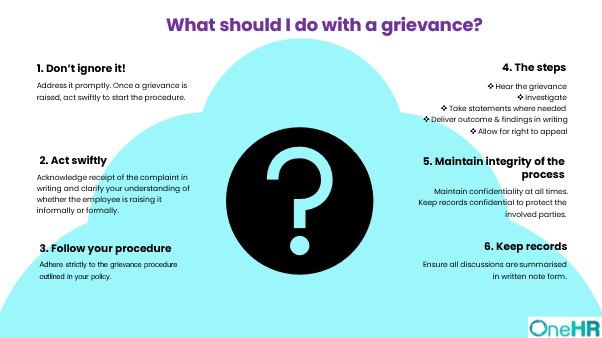
Number 4 (see picture above) typically involves, after the acknowledgment has been sent:
- Holding a grievance hearing with the employee to go through their ground for grievance and understand what they want out of it. Also, when you will identify any witnesses who should provide a statement.
- Investigating the issue thoroughly, starting with inviting any party named in the grievance as responsible to respond to the grievance.
- Following with taking statements from all identified witnesses, whether they are named by the aggrieved employee or named by the person/s ‘accused’.
- Delivering the outcome of the investigation in writing to the employee who raised the grievance, clearly outlining the findings for each allegation. This letter should also clearly show actions that will be taken and learnings for all/some parties and the organisation.
- Allowing the right to appeal if the employee feels the grievance has not been satisfactorily investigated or resolved.
Could the grievance have been prevented?

We can’t say for definite whether a grievance can be entirely prevented because it very much depends on the nature of the complaint and the allegations raised. However, as experienced HR professionals, we believe that preventing grievances usually starts with a proactive approach to workplace culture:
- Regular Training and Updates: Keep all employees updated on policies and ensure everyone understands their rights and responsibilities.
- Feedback Mechanisms: Implement regular surveys or feedback mechanisms to gauge employee satisfaction and detect potential issues early.
- Promote a Positive Workplace Culture: Foster an inclusive and respectful working environment. Recognise and reward good work, celebrate diversity, and encourage teamwork.
Receiving and managing grievances might seem daunting but it is possible to resolve disagreements before they become formal; by establishing robust policies, training managers, maintaining open communication, and fostering a positive work culture, most grievances can be effectively prevented or managed to a satisfactory resolution. This not only improves employee satisfaction but also enhances productivity and protects the business legally and reputationally.
A useful approach to resolving complex grievances that may have built up and up over the years is by using workplace mediation. Whether you have internal staff who are trained and accredited, such as your HR Adviser, or use an independent workplace mediator, it is a highly beneficial method for resolving workplace grievances.
Tell me more about workplace mediation

Workplace mediation promotes constructive dialogue and mutual understanding between parties involved in a conflict. Here’s how mediation can be a valuable tool for your business:
It preserves relationships
Workplace mediation focuses on open communication and understanding, which can help preserve and even strengthen working relationships. It encourages parties to explore underlying issues in a non-confrontational setting, thereby reducing the likelihood of strained relations which often result from more adversarial processes like formal grievances or litigation.
It reduces costs
Resolving disputes through mediation can be significantly less expensive than going through formal grievance procedures or legal actions. It saves on potential legal fees, reduces the amount of time managers and employees spend away from their work, and cuts down the costs associated with employee turnover due to unresolved conflicts.
It improves confidentiality
Mediation is a private process where the details of the discussion are not disclosed to outsiders and often not documented in employee records. This confidentiality can make it easier for employees to express their concerns freely, leading to more effective resolutions.
It offers a faster resolution
The mediation process is generally much quicker than formal procedures. It can be arranged as soon as both parties agree to it, often leading to a resolution in a matter of days. This swiftness helps minimise disruptions to the workplace and reduces the emotional and productivity toll that prolonged conflicts often entail.
It empowers employees
Mediation empowers employees by giving them a voice in the resolution process, increasing their satisfaction with the outcome; as they have a hand in shaping the agreement reached, it can improve morale and encourage trust and commitment to your organisation.
It increases flexibility
Workplace mediation offers a more flexible approach to resolving disputes. Unlike formal procedures that usually come with more rigid steps, mediation allows parties to come up with creative, tailor-made solutions that work best for everyone involved. There is no doubt that using workplace mediation can be a powerful way for employers to handle disputes effectively while maintaining a positive and collaborative work environment.
If you would like to discuss how we can help with a grievance, training or workplace mediation, contact us today


